 Napoleon is appointed as the commander of the Army of Italy
Paul François Barras, the member of the Directory to whom Napoleon owed this command, later wrote that to persuade his colleagues to choose Bonaparte for the campaign, he told them that, as a Corsican and a highlander, he was accustomed since birth to scale mountains. Barras also said that Napoleon would lift the Army of Italy out of its lethargy. On that last point he was correct. Despite the prevalent opinion at the time that it was nothing but a political appointment received not for military ability but for taking Barras’ mistress Josephine off his hands, Napoleon, who inherited a demoralised, starving and discontented army, turned things around and led it to greatness. Before Napoleon embarked on his Italian campaign, someone mentioned to him that he was too young to lead an army, to which the general replied: ‘I will be old when I return.’
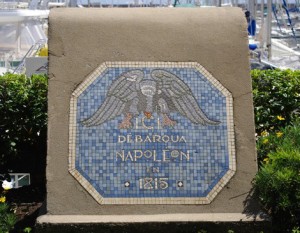 Napoleon disembarked in Golfe-Juan, between Cannes and Antibes, on the French Riviera, with a total force of 1,142 men and 2 light cannon. He was about to embark on the most fascinating endeavour in history, an event unprecedented in the past and unlikely to ever be repeated in the future. With the armies of all nations of Europe against him, he would retake Paris without firing a shot. ‘After the fall of Paris, my heart was torn apart but my spirit remained resolute. Frenchmen, in my exile I heard your complaints and wishes. So, amid all sorts of dangers, I arrived among you to regain my rights, which are yours,’ he stated in his proclamation.
 The brig Inconstant, with Napoleon on board and accompanied by a small flotilla of six ships, departed at nine o’clock from the island of Elba. Profiting by the British commissioner Neil Campbell’s absence, Napoleon was able to escape with a little over 1000 men. ‘Paris or death!’ cried the grenadiers, once they were told on board The Inconstant that they were headed for France.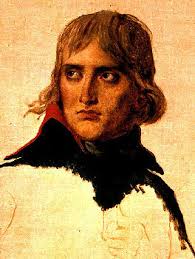
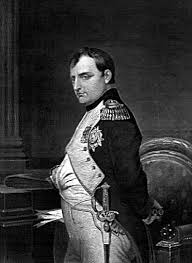
 Napoleon moved from Luxembourg to the Tuileries, becoming the first ruler to live there since Louis XVI was taken away to the Temple prison in 1792, an event Napoleon had witnessed as a young officer. The First Consul took Louis XVI’s first floor apartments overlooking the gardens, while Josephine occupied Marie-Antoinette’s suite on the ground floor. ‘I can feel the Queen’s ghost, asking what I’m doing in her bed,’ she told a chamberlain.
 The Count of Provence (future Louis XVIII) wrote to the First Consul, requesting to be allowed to return to France. Louis promised the First Consul any post in the kingdom, if only he restored him to the throne.
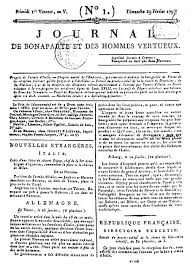 Napoleon was highly conscious of the power of propaganda. He dictated various articles to the Journal with the aim to increase his popularity, such as ‘Bonaparte files like lightening and strikes like a thunderbolt.’ In ten days the Journal was criticising the Directory, something it wouldn’t do without General Bonaparte’s instruction.
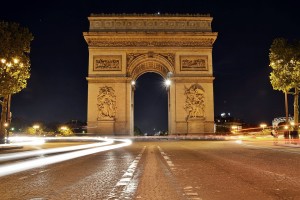 The Arc was commissioned by the Emperor Napoleon after his brilliant victory at Austerlitz and was to become the symbol of France’s military supremacy, glorifying the Grande Armée.